
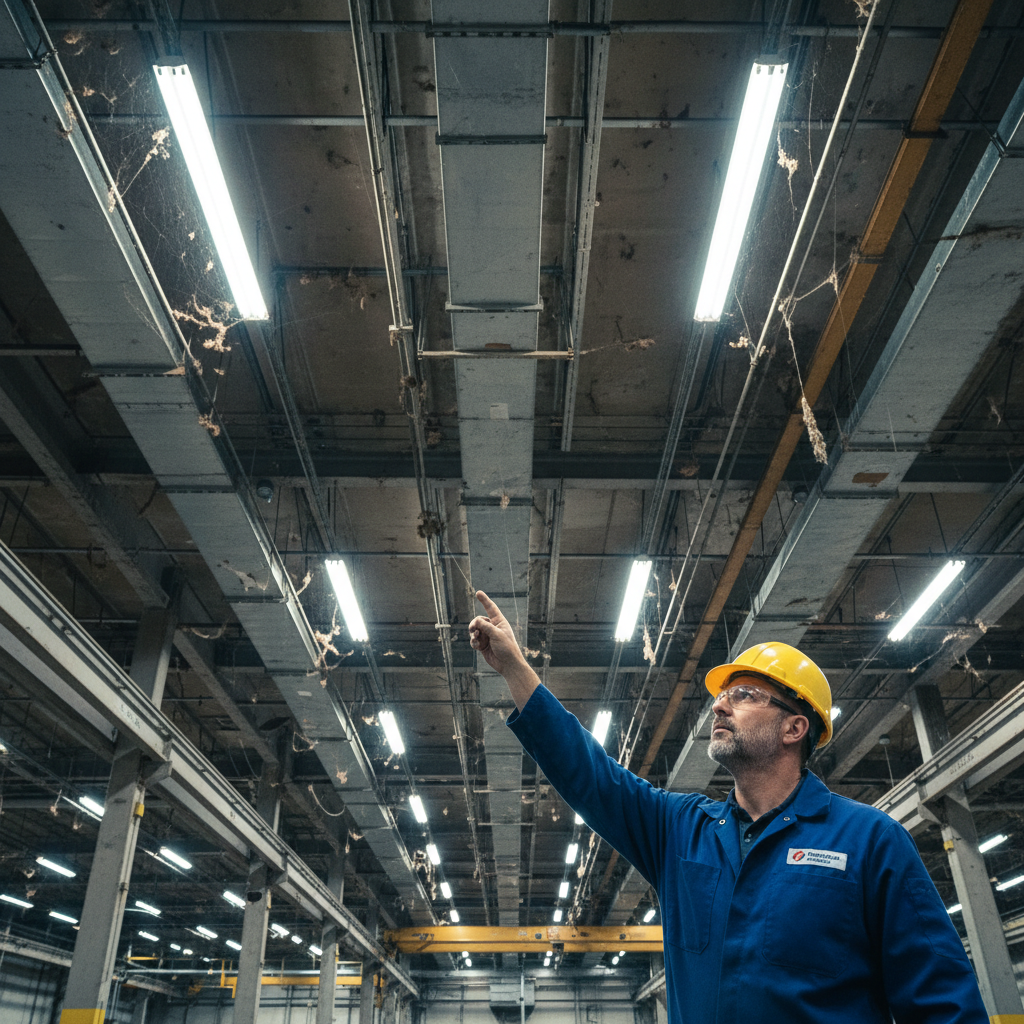
When a facility manager first calls us asking about commercial power washing services for their loading dock, we almost always end up having a very different conversation before the call ends — one about the ceiling beams, the ductwork flanges, the overhead pipe runs, and the light fixtures that nobody has touched in two, sometimes three years. The loading dock gets cleaned. But thirty feet above the production floor, a slow-moving disaster has been building, one dust particle at a time.
In 2026, with indoor air quality standards tightening across Ontario and health inspections in the GTA carrying real financial consequences, that overhead disaster is no longer something corporate facility teams can quietly defer. High-surface dust is a compliance issue, a liability issue, and — if you manage people in that building — a basic duty-of-care issue. It is also, candidly, one of the most under-serviced areas in commercial facility maintenance across Mississauga, Brampton, and the broader Toronto region.
This is the story of what actually lives above your heads, why it stays there, and what happens when the wrong set of eyes finally looks up.
⚡ QUICK ANSWER
High-surface dust accumulation on overhead beams, ductwork, lighting rigs, and suspended ceilings degrades indoor air quality, shortens HVAC equipment lifespan, and creates visible compliance failures during health and safety inspections. Professional high-dusting services — performed by trained teams with the right equipment — eliminate these risks before they become regulatory events. Green Maples Environmental Inc provides scheduled high-dusting programs for medium to large facilities across the GTA, including Mississauga, Toronto, Brampton, and Oakville.
What Is High-Dusting, and Why Does It Get Ignored?
High-dusting is the systematic cleaning of overhead and elevated surfaces — beams, trusses, ductwork, pipe runs, sprinkler heads, light fixtures, overhead signage, and suspended ceiling tiles — typically above ten feet, where standard cleaning equipment and routine janitorial staff cannot safely reach. It is ignored primarily because it is invisible at eye level, and invisibility is the enemy of any maintenance budget.
Here is the dynamic we observe repeatedly across GTA corporate campuses and industrial facilities: the lobby is immaculate, the washrooms are on a twice-daily schedule, the floors have a dedicated stripping and buffing program. But the moment you look up — past the second row of recessed lights, up to where the HVAC return runs meet the structural steel — the building tells a completely different story. Grey-brown accumulations coat every horizontal surface. Fibrous clumps hang from cable trays. Sprinkler deflectors wear a thick collar of compacted particulate.
This is not a cleanliness complaint. It is an engineering and health problem wearing the costume of a housekeeping oversight.
According to the Canadian Centre for Occupational Health and Safety (CCOHS), settled dust in workplaces can become re-entrained into breathing zones through HVAC airflow, foot traffic vibration, and even the simple act of opening a loading bay door. Once airborne, those particles — which by this point carry allergens, mold spores, VOC residue, and fine particulate matter — distribute evenly throughout the occupied space. The people working beneath that ceiling are breathing what you have been ignoring overhead.
The Accumulation Timeline Nobody Tracks
In a typical Mississauga warehouse or multi-floor corporate office, overhead surfaces begin collecting meaningful dust deposits within sixty days of a thorough cleaning. Within six months, those deposits become dense enough to affect air quality readings at occupant level. Within twelve to eighteen months, the accumulation is visible to any inspector — or any client — who looks up during a site walk.
Most facilities we audit have not had a documented high-dusting service in over two years. Several have never had one.
How Does Overhead Dust Actually Affect Air Quality and Equipment Life?
Overhead dust affects air quality by acting as a persistent reservoir of fine particulate, allergens, and biological matter that re-enters breathing zones continuously — and it shortens equipment lifespan by coating HVAC components, sensors, and motors with insulating layers of debris that force systems to work harder and fail sooner.
Let us separate this into its two distinct damage streams, because facility managers typically budget for either air quality or equipment maintenance — rarely acknowledging that the same neglected ceiling beam is driving costs in both columns simultaneously.
On the air quality side: According to the U.S. Environmental Protection Agency (EPA), indoor air can be two to five times more polluted than outdoor air, with settled dust and poor HVAC maintenance among the primary contributing factors in commercial buildings. In Ontario facilities, where buildings are sealed tightly for six to eight months of the year for heating efficiency, that multiplier effect is especially pronounced. High-surface accumulations function as a slow-release reservoir, continuously shedding particulate into the building’s air circulation system regardless of how frequently you clean at ground level.
On the equipment side: According to the American Society of Heating, Refrigerating and Air-Conditioning Engineers (ASHRAE), a layer of dust as thin as 0.042 inches on a heat exchange surface can reduce HVAC system efficiency by up to 21%. In a mid-size corporate campus in the Mississauga or Brampton corridor — where HVAC replacement costs run into the hundreds of thousands — that efficiency loss translates directly into capital expenditure being accelerated by a cleaning problem that costs a fraction of the damage to prevent.
“A layer of dust as thin as 0.042 inches on a heat exchange surface can reduce HVAC efficiency by up to 21%. The cleaning problem costs a fraction of the equipment problem it causes.” — ASHRAE research, cited by Green Maples Environmental Inc
The compounding irony is this: facilities that invest in regular floor care programs, Public Transportation Cleaning protocols, or thorough washroom maintenance — all of which we applaud — are often recycling their investment by pulling contaminated air from a neglected overhead zone directly into their recently cleaned spaces. You cannot clean the bottom half of a building in isolation. The building is a system.
Why Do Health Inspectors and Safety Auditors Always Look Up?
Health inspectors and workplace safety auditors consistently focus on overhead surfaces because dust accumulation at elevation is one of the fastest, most reliable indicators of a facility’s overall maintenance culture — and because overhead dust near food preparation, pharmaceutical processing, or open electrical equipment represents immediate, documentable risk.
This is not a secret known only to inspectors. Experienced facility managers in the GTA know it too. The problem is that high-dusting requires specialized equipment — articulating extension poles, aerial work platforms, HEPA-filter vacuums capable of capturing dislodged particulate before it settles on the floor below — and a cleaning crew trained and comfortable working at elevation. It is not a task that can be delegated to the overnight janitorial team with a standard mop handle.
When an Ontario Ministry of Labour inspector walks into a Brampton distribution centre and sees compacted dust on the structural steel above an active picking line, the conversation that follows is not a gentle suggestion. It is a written order, a reinspection date, and — in documented cases — a stop-work notice while conditions are remediated. The financial impact of a single such event — lost productivity, emergency cleaning costs, potential fines, and reputational damage with clients who were on-site that day — typically dwarfs years of preventive high-dusting program costs.
The Connection to Post-Construction Cleaning
One scenario where overhead surface contamination reaches its most severe levels is following building renovations or tenant fit-outs. Drywall dust, concrete particulate, and fibreglass insulation fragments settle on every elevated horizontal surface during construction — and they are extraordinarily fine, making them both deeply penetrating into HVAC systems and stubbornly adhesive to structural surfaces. Our teams provide post-construction cleaning and post-renovation cleaning services across the GTA specifically because construction-phase contamination, if not addressed systematically from the top down, becomes the baseline air quality problem for every year that follows in that space.
We have entered Mississauga office tower floors that were handed over to tenants after a renovation supposedly including final clean. The ground-level finishes were spotless. The overhead cable management was still wearing a full coat of joint compound dust. That dust was already being pulled into the building’s fresh air intake.
What Makes Green Maples Environmental Inc’s Approach Different?
At Green Maples Environmental Inc, our approach to high-surface cleaning is different because we treat it as a system-level intervention rather than a standalone task — always assessing how overhead contamination connects to HVAC intake points, floor-level air quality, and the facility’s broader maintenance rhythm before a single pole is extended.
We are headquartered in Mississauga and serve medium to large corporate and commercial facilities across the GTA, including Brampton, Oakville, Toronto, and the surrounding region. Our environmental mandate — it is in our name, and it genuinely guides our service design — means we prioritize HEPA-capture processes that contain dislodged particulate rather than simply redistributing it to lower surfaces. We use green commercial cleaning services methodologies and products wherever possible, reducing the chemical load introduced into the building’s air during the cleaning process itself.
That word — environmental — matters operationally, not just as branding. When you are working at elevation above occupied or semi-occupied spaces, the products and techniques you use have a direct, immediate impact on the air quality of the space you are cleaning. Harsh solvent-based degreasers used on overhead ductwork without proper containment introduce VOCs into the building’s breathing zone at precisely the moment the overhead surfaces are being disturbed. Our green commercial cleaning protocols eliminate that risk by design.
A Complete Overhead Cleaning Service Scope
When our team performs a high-dusting program at a GTA facility, the scope typically includes structural steel beams and columns, exposed ductwork and HVAC supply/return diffusers, pipe runs and cable trays, sprinkler heads and fire suppression infrastructure, overhead lighting fixtures and pendant mounts, suspended ceiling grid frames and tiles where accessible, signage and wayfinding hardware, and overhead storage rack structures in warehouse environments.
In facilities where exterior surfaces are also a concern — loading areas, canopies, concrete facades — we coordinate high-dusting programs with commercial pressure washing and commercial power washing Ontario-compliant exterior services so the facility is addressed comprehensively in a single mobilization. This coordination is especially valuable for multi-site corporate clients managing facilities across Mississauga, Brampton, and the broader Ontario region, where mobilization efficiency translates directly into budget efficiency.
We also support facilities that require broader community and campus-level programs. Our teams have worked alongside Non Profit Organizations Cleaning Services In Ontario to bring the same rigorous overhead cleaning standards to community facilities that often lack the dedicated maintenance budgets of private-sector counterparts — because clean air does not discriminate by building type.
How Should GTA Facilities Build a High-Dusting Program That Actually Holds?
A high-dusting program that holds long-term should be structured around documented service intervals — typically every three to six months depending on facility type and occupancy — with photographic before-and-after records maintained in a compliance-accessible format, so that when an inspector arrives, the facility manager has evidence of diligence rather than a defensive explanation.
Here is the framework we recommend to new clients in the Mississauga and GTA region when they are designing or rebuilding their overhead maintenance program:
Step one: Establish a baseline. Before setting an interval, you need to know what you are starting with. An initial comprehensive high-dusting — often combined with post-construction cleaning if a renovation has occurred in the past few years — establishes a documented clean baseline and surfaces any conditions (moisture damage, mold indicators, pest activity, damaged insulation) that need separate remediation before the ongoing schedule begins.
Step two: Segment by risk zone. Not all areas of a facility accumulate at the same rate or carry the same consequence if they are dirty. A kitchen exhaust zone accumulates differently than a server room intake zone, which accumulates differently than open warehouse structural steel. Map your facility’s risk zones before assigning a single blanket interval.
Step three: Coordinate with other service lines. High-dusting that is scheduled in isolation — without coordination with your HVAC filter change cycle, your floor care program, or seasonal exterior work like commercial pressure washing — misses significant efficiency gains and can create circular contamination where a freshly cleaned ceiling becomes re-contaminated from a dirty HVAC filter change two weeks later.
Step four: Document everything. The moment an inspector or insurer asks for maintenance records, a verbal assurance that “we do it regularly” is worth nothing. Photographs dated and geotagged, service reports signed by site supervisors, and a rolling twelve-month log create the paper trail that turns good maintenance practice into a defensible compliance position.
Our team at Green Maples Environmental Inc provides all of this documentation as a standard deliverable on every high-dusting engagement — not as an add-on. We understand that our clients are accountable to their own stakeholders, and a cleaning company that cannot produce evidence of its own work is not genuinely supporting that accountability.
Ready to Look Up — and Actually Like What You See?
If your facility has not had a documented high-dusting service in the past six months, the overhead surfaces in your building are working against every other cleaning investment you make. Our team at Green Maples Environmental Inc serves Mississauga, Brampton, Toronto, Oakville, and the broader GTA with professional, scheduled overhead cleaning programs built for corporate compliance and long-term facility performance.
✍️ Written by the Green Maples Environmental Inc Content Team — Our team of facility service specialists and environmental cleaning professionals has served medium and large commercial clients across the GTA for years, with deep operational expertise in high-dusting, post-construction remediation, and integrated facility maintenance programs. We write from direct field experience, not theory.
Frequently Asked Questions
How often should a commercial facility in Mississauga schedule high-dusting services?
Most commercial facilities in Mississauga and the broader GTA should schedule high-dusting services every three to six months, depending on facility type, occupancy density, and the nature of operations. Warehouses with active fork truck traffic, facilities adjacent to construction activity, or buildings with aging HVAC systems tend to accumulate faster and benefit from quarterly service. Corporate office environments in controlled-access towers may operate effectively on a bi-annual schedule, provided that schedule is adhered to without exception and documented properly for compliance purposes.
What surfaces are included in a professional high-dusting program?
A professional high-dusting program covers all elevated surfaces above standard reach — typically defined as above ten feet — including structural beams and trusses, exposed ductwork and HVAC diffusers, pipe runs, cable trays, sprinkler infrastructure, suspended ceiling frames, overhead lighting fixtures, signage hardware, and in warehouse settings, the top surfaces of high-bay racking systems. The specific scope is always tailored to the facility’s layout, occupancy classification, and any regulatory requirements applicable to the industry the client operates in.
Why can’t regular janitorial staff handle high-dusting as part of normal cleaning routines?
Regular janitorial staff are not equipped or trained for high-dusting for three interconnected reasons: safety, equipment, and technique. Working at elevation above ten feet requires specific fall-protection training, appropriate aerial equipment — scissor lifts, articulating boom lifts, or certified ladder systems — and HEPA-filter vacuuming equipment capable of capturing dislodged particulate before it settles on lower surfaces. Attempting high-dusting without these capabilities either leaves the contamination in place or redistributes it to the occupied zone, which is arguably worse than leaving it undisturbed. Professional high-dusting is a specialist service, not a line item on a standard janitorial scope.
Can I combine high-dusting with other facility services like post-construction cleaning or commercial pressure washing for efficiency?
Yes — and at Green Maples Environmental Inc, we actively recommend and coordinate this kind of service integration for GTA clients managing multiple facility needs simultaneously. Combining a high-dusting program with post-construction cleaning, commercial pressure washing Ontario exterior services, or floor care programs in a single mobilization reduces disruption to your operations, lowers the total cost per service through shared mobilization, and ensures that cleaning efforts across different zones of the facility are sequenced correctly — always top-down, always with clean surfaces protected from re-contamination by adjacent services. Contact our team at Www.Gmecanada.Ca to discuss a coordinated facility maintenance plan.