
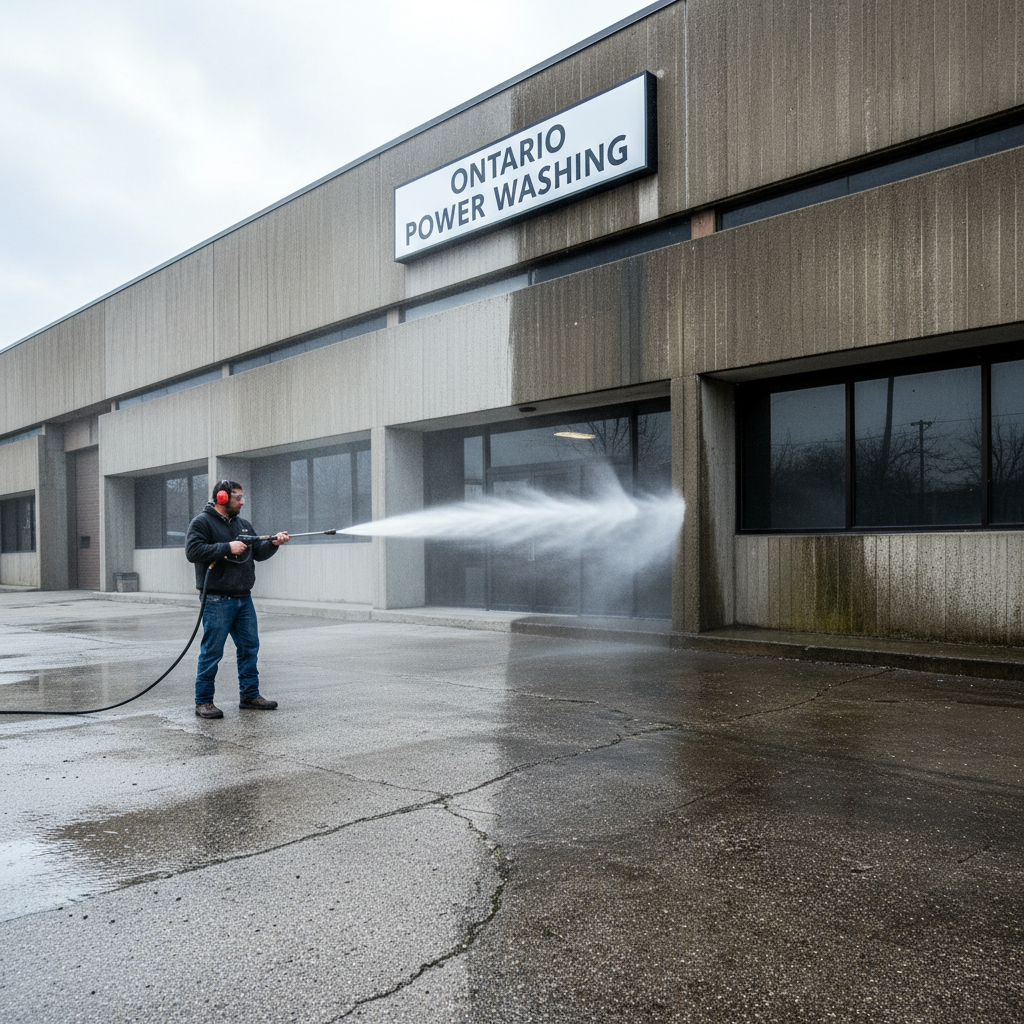
Commercial Pressure Washing Ontario: The Mistakes That Cost Businesses More Than They Realize
Commercial pressure washing Ontario facilities require is far more technically demanding than most property managers expect — and in 2026, the gap between businesses that get it right and those that don’t is getting wider, not narrower. At Green Maples Environmental Inc, we’ve cleaned hundreds of facilities across Mississauga, Brampton, Oakville, and the broader GTA, and the same costly misunderstandings keep surfacing. This isn’t a generic how-to guide. This is what we actually see on the ground — the real mistakes, the real consequences, and the mindset shift that separates a clean facility from a liability.
⚡ QUICK ANSWER
The most common mistake businesses make with commercial pressure washing in Ontario is treating it as a one-size-fits-all service. Surface material, contaminant type, water pressure calibration, and drainage compliance all vary significantly between a parking garage in Mississauga, a post-construction site in Brampton, or a retail plaza in Oakville. Using the wrong pressure or technique doesn’t just underdeliver — it damages surfaces and can void warranties. Professional assessment before every job is non-negotiable.
Why Do So Many Ontario Businesses Underestimate Pressure Washing?
Most businesses underestimate pressure washing because it looks straightforward from the outside — point a hose, apply water, done. In reality, professional exterior cleaning is a discipline with real technical complexity, and the consequences of cutting corners are felt in the asset depreciation, safety incidents, and failed inspections that follow.
Consider the numbers: according to the Building Owners and Managers Association (BOMA) Canada, deferred exterior maintenance — including surface cleaning — contributes to an estimated 15–20% acceleration in material degradation on commercial properties. That’s not a minor inconvenience. That’s capital expenditure brought forward years ahead of schedule because a pressure wash was skipped, underpowered, or performed incorrectly.
We see this pattern repeatedly across the GTA. A property manager in Mississauga hires the cheapest available crew, the surface looks acceptable immediately after, and six months later they’re dealing with embedded contaminants, biological growth, or concrete spalling that a properly calibrated hot-water extraction system would have prevented. The savings were illusory. The damage was real.
Beyond the structural concern, there’s a regulatory dimension that catches many Ontario businesses off guard. Commercial pressure washing in Ontario must comply with municipal stormwater bylaws — wastewater runoff from cleaning operations cannot enter storm drains untreated in most jurisdictions, including Mississauga and Brampton. Our team at Green Maples Environmental Inc uses proper containment, filtration, and disposal protocols on every job. This isn’t optional. It’s compliance.
“A pressure washing job that looks clean on the surface but leaves contaminated runoff in the storm system isn’t a completed job — it’s a liability waiting to surface.”
What Makes Parking Garage Cleaning in Ontario Different from Standard Pressure Washing?
Parking garage cleaning in Ontario is categorically different from standard exterior pressure washing because the contamination profile, surface sensitivity, and drainage complexity are all significantly more demanding. A parking structure accumulates oil, road salt, rubber deposits, carbon particulates, and de-icing chemicals simultaneously — and each requires a different treatment approach.
We provide parking garage cleaning in Mississauga and across Ontario, and we treat every structure as its own unique project. The concrete in a parking garage is under constant mechanical and chemical stress. Chloride intrusion from road salt is one of the leading causes of reinforcing bar corrosion in Canadian parking structures, and according to Infrastructure Canada’s Asset Management Guidance, corrosion-related deterioration is responsible for billions of dollars in premature concrete infrastructure failure annually across the country. Aggressive cleaning without pH-neutral solutions or proper neutralization steps can accelerate this process rather than slow it.
Commercial parking garage cleaning demands hot-water pressure systems, appropriate dwell-time for degreasing agents, structured drainage management, and adherence to ventilation protocols when crews are operating in enclosed deck levels. It also demands scheduling intelligence — a garage that services a high-volume office tower in Mississauga cannot simply be shut down during business hours. Our team works around occupancy schedules without compromising thoroughness.
The firms that treat parking garage washing as a commodity service are the same firms that leave oil staining unchanged, miss drain cleaning in Mississauga that has become restricted with sediment, and create slip-and-fall hazards by applying water to surfaces without appropriate wet-floor protocols. Those are the calls we get after the fact.
How Does Post-Construction Cleaning Connect to Pressure Washing?
Post-construction cleaning and commercial pressure washing are deeply connected because construction sites leave behind surface-level contamination — concrete splatter, adhesive residue, caulking overspray, efflorescence, and construction dust — that cannot be addressed with interior cleaning alone. Exterior pressure washing is almost always a required phase of any complete post-construction cleaning scope.
Our post-construction cleaning in Brampton and surrounding areas typically involves a staged exterior clean that uses variable pressure settings depending on surface type. New masonry is treated differently than glass curtain wall, which is treated differently than poured concrete. Post-renovation cleaning carries the same complexity — renovation debris often includes compounds that bond chemically to surfaces over time, making early intervention critical.
One pattern we’ve observed consistently: developers and general contractors often schedule post-construction cleaning as the final item on the punch list, which means it gets compressed. Crews are rushed, surface types get treated uniformly, and the result is a facility that looks acceptable at handover but develops visible staining or etching within months. This is preventable with a properly scoped and sequenced cleaning plan — something our team builds into every post-construction engagement from the outset.
Is Floor Waxing in Oakville Part of the Same Maintenance Picture?
Yes — floor waxing in Oakville and surrounding communities like Burlington is absolutely part of the same integrated facility maintenance picture. While pressure washing addresses exterior surfaces, floor stripping and waxing addresses the interior surfaces that absorb foot traffic, moisture, and daily abuse. Both are protective processes: one seals exterior materials against environmental damage, the other seals interior flooring against wear-through and contamination.
We provide floor waxing in Oakville for commercial and corporate facilities, and the questions we get most often are variations of the same theme: “How often does it need to be done?” and “What’s the right product for our floor type?” The answer to both depends on traffic volume, floor substrate, and the quality of the finish applied originally. A VCT floor in a high-traffic Oakville retail space will need stripping and recoating differently than a polished concrete floor in a corporate Mississauga lobby.
Floor waxing in Burlington follows the same discipline. Burlington’s commercial sector includes a strong mix of light industrial, professional office, and retail — each with different flooring demands. Our approach to floor stripping and waxing is always substrate-specific: we assess the existing finish condition, strip to bare surface when necessary, apply the correct number of coats for the traffic category, and burnish to the appropriate sheen level. A floor that looks glossy but was waxed over a contaminated base will degrade faster than one that was properly prepped.
The connection to green commercial cleaning services is worth noting here as well. At Green Maples Environmental Inc, we prioritize low-VOC, environmentally responsible products in our floor care programs — products that protect the flooring investment without compromising indoor air quality for the employees and visitors in the space. Green commercial cleaning isn’t a marketing label for us. It’s a procurement standard built into every service line we offer.
“Floor waxing done right protects the asset. Floor waxing done wrong — applied over an unstripped or contaminated base — simply buries the problem under a shiny layer that will fail ahead of schedule.”
What the Right Commercial Cleaning Partner Actually Looks Like
The right commercial cleaning partner in Ontario is not the one with the lowest per-square-foot quote. It’s the one whose team understands surface science, local regulatory requirements, and the operational constraints of your specific facility — and can execute without disrupting your business.
At Green Maples Environmental Inc, we’ve built our reputation across Mississauga, Brampton, Oakville, Burlington, and the broader GTA by taking every service category seriously — whether that’s commercial power washing Ontario businesses rely on for exterior maintenance, event cleaning services for corporate functions, graffiti removal for commercial properties, or community cleaning services for organizations with shared-use facilities. We also serve specialized environments — from Public Transportation Cleaning to Non Profit Organizations Cleaning Services In Ontario — because facility cleanliness isn’t a luxury in any of these environments. It’s a baseline.
According to a 2023 ISSA (Worldwide Cleaning Industry Association) report, facilities that invest in structured, professionally managed cleaning programs see up to a 50% reduction in flooring replacement costs and a measurable improvement in occupant satisfaction scores. Clean facilities aren’t just aesthetically better — they perform better, retain tenants and employees more effectively, and generate lower long-term maintenance costs. That’s the business case for doing this properly, and it’s the case we make to every client we work with.
The GME team doesn’t treat facilities as interchangeable. We know that a Mississauga corporate campus has different requirements than a Brampton industrial facility or an Oakville professional office building. Local knowledge, technical expertise, and genuine accountability — that’s what we bring to every contract.
Ready to Get It Right the First Time?
Whether you need commercial pressure washing, parking garage cleaning, post-construction cleaning, floor waxing, or a comprehensive facility maintenance program across Mississauga, Oakville, Brampton, or anywhere in the GTA — our team is ready to assess your facility and deliver a solution that actually works.
✍️ Written by the Green Maples Environmental Inc Team
Green Maples Environmental Inc is a Mississauga-based commercial cleaning and facility management company serving medium and large businesses across the GTA. With expertise spanning commercial pressure washing, floor care, post-construction cleaning, and parking structure maintenance, our team brings technical precision and local accountability to every engagement.
Frequently Asked Questions
How often should commercial pressure washing be done on Ontario properties?
Most commercial properties in Ontario benefit from exterior pressure washing at least twice per year — once in spring to address road salt, sand, and winter debris, and once in fall before freeze-up. High-traffic surfaces like parking garage floors, loading docks, and building entrances may require quarterly attention. The right frequency depends on your facility’s traffic volume, surface material, surrounding environment, and industry-specific hygiene standards. Our team at Green Maples Environmental Inc assesses each property individually before recommending a cleaning schedule.
What is the difference between commercial power washing and commercial pressure washing?
Commercial power washing uses heated water combined with high pressure, while commercial pressure washing typically refers to high-pressure water at ambient temperature. The heat in power washing significantly improves the removal of grease, oil, biological growth, and road grime — making it the preferred choice for parking garages, loading bays, and food service exterior areas. For more delicate surfaces like newer masonry or painted concrete, cold-water pressure washing with appropriate pressure calibration is often the better option. Understanding which method to apply is a core part of what separates professional facility cleaning from commodity services.
Why does floor waxing in Oakville and Burlington require professional application?
Professional floor waxing requires specialized equipment, proper surface preparation, and product knowledge that in-house janitorial staff typically don’t have access to. Applying wax over a floor that hasn’t been properly stripped and cleaned results in product layering, yellowing, and premature failure — costing more to correct than if the job had been done professionally from the start. Commercial floor stripping and waxing in Oakville and Burlington involves industrial strippers, low-speed and high-speed burnishing equipment, and multi-coat finish systems matched to the specific floor substrate and traffic category of the space.
Can I combine post-construction cleaning with ongoing facility maintenance through the same provider?
Yes — and in most cases, transitioning directly from post-construction cleaning to an ongoing maintenance program with the same provider delivers better outcomes and lower long-term costs. A provider who performed the post-construction clean understands the surface conditions, product compatibility, and any site-specific challenges already documented during that initial scope. At Green Maples Environmental Inc, we actively encourage this transition for clients in Mississauga, Brampton, Oakville, and across the GTA — the continuity of knowledge translates directly into a better-maintained facility over time.